

At the APS Global Summit in Denver last week, one message came through loud and clear: real-time quantum error correction is no longer a future priority — it’s an immediate engineering challenge, and the industry is moving faster than most expected.
Across booths, talks, and conversations with attendees among the conference’s 14,000 participants, APS confirmed what Riverlane’s roadmap has long anticipated: real-time QEC has become a defining requirement on the path to utility-scale quantum.
We showcased this first-hand, demonstrating live how our QEC hardware and software work together in an end-to-end quantum computing workflow, the first public demo of its kind.
The industry’s first end-to-end real-time QEC demo
Debuted publicly for the first time, our live demo of Deltaflow 2, our real-time QEC system, alongside Deltakit, our open-source software development kit offered attendees something unavailable anywhere else: a clear, practical demonstration of fault-tolerant QEC running in real-time.
The demo highlighted the significant progress Riverlane has made over the past 12 months, while also bringing into focus the critical advances still required to unlock scalable quantum computing.
Attendees were guided through a full QEC cycle, illustrating how Deltaflow 2 and Deltakit work together in practice. For fault-tolerant quantum computing, every microsecond counts: if error correction cannot keep pace with the qubits, the computation fails. That’s why the demo’s full end-to-end latency measurements, covering both data routing and processing, were so significant. Latency isn’t just a decoding challenge; it spans the entire system.
We demonstrated tangible progress toward low-latency QEC across three core areas:
- Faster decoding: leveraging a Local Clustering Decoder (LCD) implemented on FPGA
- QECi physical layer: enabling low-latency FPGA-to-FPGA communication
- End-to-end latency measurement: capturing system-wide performance externally, reinforcing that QEC spans data processing and routing, not just decoding
Together, these advances show how reducing latency and improving throughput directly increase the number of error-corrected quantum operations a system can perform, accelerating the path to utility-scale quantum computing.
If you weren’t at APS, you can watch the full demo here.
Ecosystem momentum: QEC integration moves forward
Beyond our own demo, APS made it clear that real-time QEC is becoming an ecosystem effort, with partners across the stack actively building toward integrated solutions.
Riverlane announced the integration of its Deltaflow 2 quantum error correction system with Qblox’s high-performance control hardware to enable real-time QEC reflecting a broader shift toward integrating QEC directly into the control stack.
That shift was visible across partner booths and sessions throughout the week:
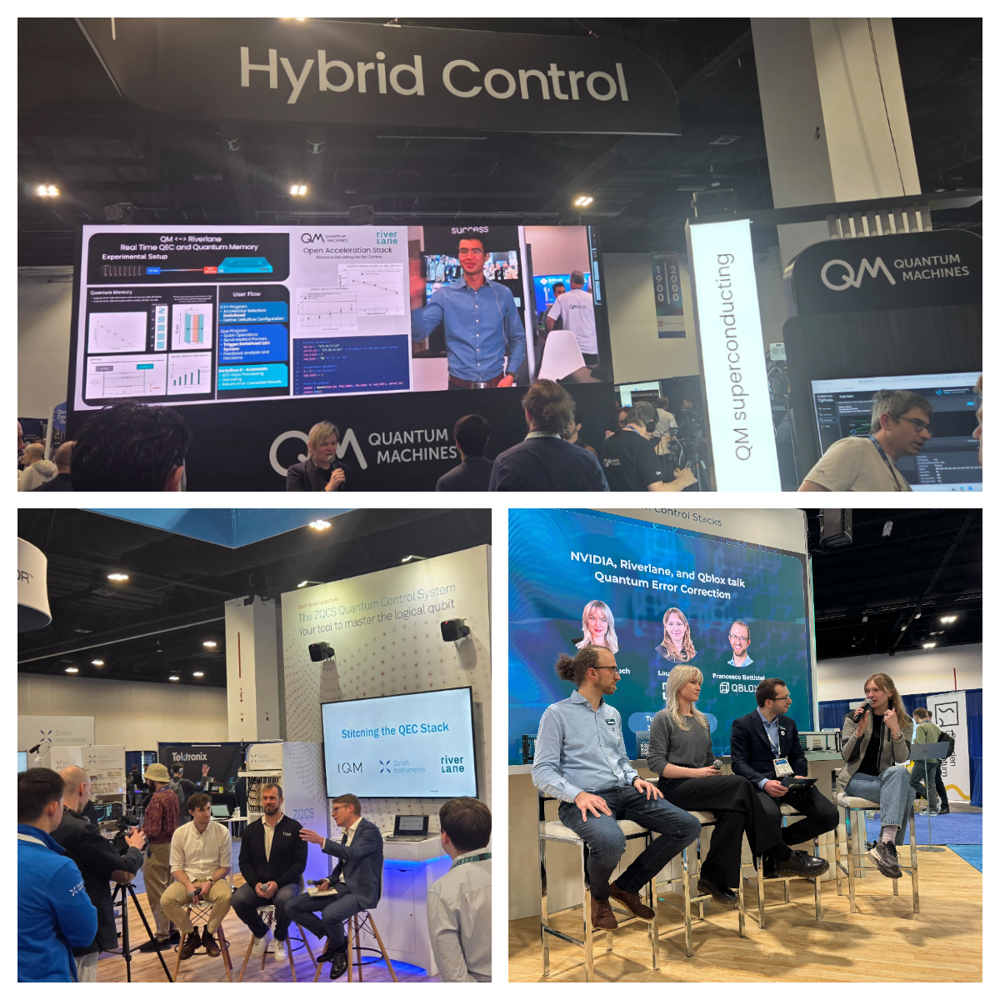
- At the Qblox booth, discussions focused on how control systems and QEC must work together in practice. A panel on quantum error correction brought together perspectives from NVIDIA, Qblox, and Riverlane, highlighting the growing importance of decoding performance and system-level integration.
- Quantum Machines demonstrated a joint setup combining its OPX-1000 control system with Deltaflow 2, running streaming quantum memory with low-latency decoding. The demo formed part of its broader Open Acceleration Stack, which aims to unify control, classical processing, and real-time feedback into a single architecture.
- Zurich Instruments also emphasised system-level integration in its panel on “Stitching the QEC Stack,” where Riverlane joined alongside IQM to discuss how different layers of the stack must work together to deliver practical QEC.
Across these interactions, a consistent picture emerged. Control system providers and hardware companies are no longer treating QEC technology as a future requirement. It is becoming a core part of their roadmaps today.
Three QEC themes that defined APS 2026
1. QEC practicality and integration
The clearest shift across talks was the move from theoretical QEC to real-world implementation. IBM, Qblox, and Zurich Instruments are advancing the enabling technologies that make this possible: low-latency interfaces such as QECi, control systems, and compiler integrations that support end-to-end QEC workflows. Alice & Bob made the case for open-source compiler interfaces and hardware/QEC code abstraction. The field is also shifting from logical qubit storage toward computation, with early progress in logical operations, efficient circuit design, and techniques such as magic state injection.
2. QEC codes, specifically qLDPC, remain a hot topic
qLDPC codes continue to attract significant attention, particularly for quantum memory applications, with QuEra, IQM, IBM, and others exploring them across qubit modalities. For surface codes, the focus has moved from foundational decoder development toward decoding logic and tighter decoder-controller integration, reflecting a broader shift to systems-level thinking. Algorithmic innovation is also accelerating: the University of Maryland showed progress with a BP decoder, IBM with the RelayBP decoder, and the Lukin group demonstrated strong logical error rates using ML-based decoders trained at threshold to generalise to very low error regimes.
3. Hardware-software co-design and scaling
Achieving utility-scale quantum requires hardware and software to be developed together, and that message was consistent throughout APS. Demand for open, flexible, interoperable architectures came up repeatedly, from open-source compiler interfaces to modular system designs. Quantum Machines highlighted real-time injection of calibrated parameters; control system teams are scaling by connecting additional hardware units using FPGA and GPU-based decoding. IonQ's distributed architecture, using fast physical ion shuttling across 2D arrays, illustrated the range of hardware strategies being pursued to reach scale.
What comes next
APS 2026 was the clearest signal yet that the quantum industry has moved past asking whether QEC is necessary. The question now is how to make it fast enough, practical enough, and integrated enough to power the next generation of quantum computers.
Real-time QEC is the defining bottleneck. Solving it will determine how quickly quantum computing reaches utility scale. Riverlane’s focus remains clear: building the real-time QEC technology that enables this transition, accelerating the arrival of utility-scale quantum computing for the entire ecosystem.
Watch our demo to see our QEC technologies in action and read our roadmap to see where we are headed next.